Most national parks are now extremely busy during the summer months, with traffic having increased noticeably since 2020.
Consider recent statistics for my neighboring park, Grand Teton. Logging more than 3.8 million recreational visits, 2025 was the second busiest on record – exceeded only by 2021 at 3.88 million. 2026 year-to-date is running neck and neck with 2025.
[Note: “visits” does not equate to “visitors.” If you come through the gate twice in a single day, that’s counted as two recreational visits. Still, those are big numbers.]
Once upon a time – up until very recently, actually – the shoulder months of May and October were reliably quiet. Not anymore. October 2025’s 281,000 visits set a record, and May of 2026 also surpassed a previous all-time high (366,252).
Like it or not, tourist season now covers five months. July is busiest.
If you’re seeking peace and quiet in wide open spaces, summer in the park might not be your cup of tea. (Photographers beginning their days in the darkness before dawn can still avoid massive crowds, but even at that hour some of the more popular locations have become overrun.)
Fortunately, there’s a lot more to the calendar outside of high season. Consider taking advantage of the rest of the year; you’ll be glad you did.
Grand Teton National Park is spectacularly beautiful no matter when you see it. Want proof? Here's a taste of what you might find, beginning with spring – my favorite time of year.
First, it’s important to articulate what “spring” means here in the Rockies. It arrives late and typically lasts until well into June. Most of the park doesn’t begin to open up (campgrounds, marinas, restaurants) until May – in many areas, late May. Overnight temperatures can dip into the 20s. Expect to find some snow on the ground; you’ll certainly encounter it on higher elevation trails. The mountains will still be fully dressed in winter white.
In my view, the park is never more beautiful than during springtime. The juxtaposition of snow-covered peaks with the lime greens of trees newly leafed out is stunning. The meadows and valley floors are verdant, blanketed with grasses, sedges, and – beginning in June – wildflowers. Because the mountains are still snow-covered, alpenglow is amplified. Chances for precipitation – whether rain or snow – are good.
For a transient period of time, this high-altitude, normally arid landscape is surprisingly lush.

WALKING ON SUNSHINE
TETON DREAMS
In the summer months, you’ll still find wildflowers at higher elevations while the valley floors will be drying out and giving up their greens. By late July, the mountains will have lost all remaining snow cover. The most visually compelling summer conditions are now often above your head.
Because the Tetons are further north than the primary North American monsoon core, the number and intensity of summer storms is variable; these types of conditions are far from a sure thing. When we’re lucky enough to get monsoonal-related weather activity, though, it creates very interesting skies.

LEADING EDGE

TURMOIL ALOFT
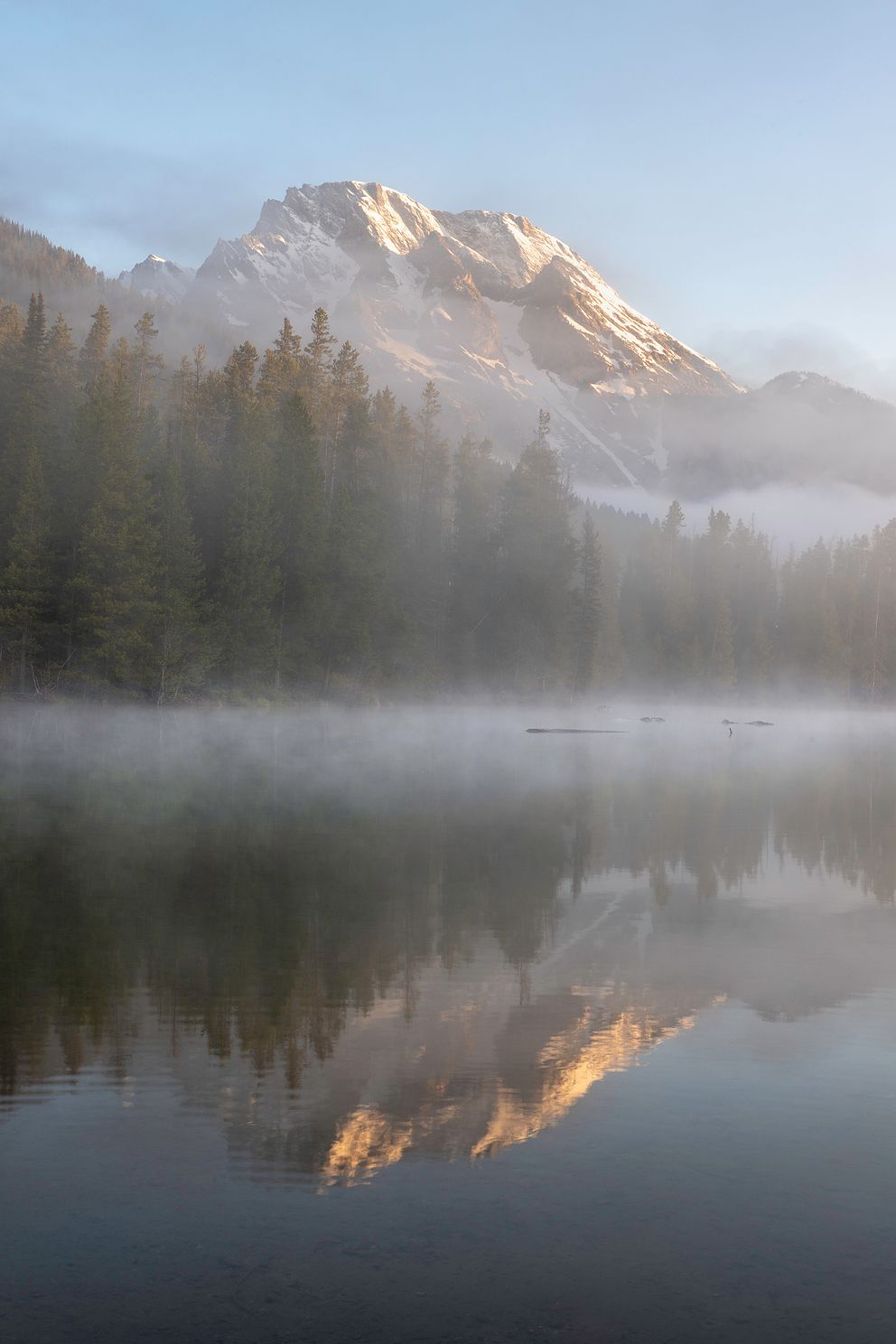
Autumn in Grand Teton National Park is a season of transition on many levels. The sun is noticeably lower in the sky; aspens and cottonwoods turn golden; nights are cold and crisp; wildlife are active as migration begins; the elk rut gets underway; the first snows dust the mountain peaks.
Though much busier than it used to be during Septembers of the not-so-distant past, the mid-summer throngs will be gone. Things will be slowing down a bit. All trails remain open, but use caution when hiking. Bears are busy foraging in preparation for hibernation, and elk are aggressive when in the rut.
Jackson Lake is routinely drawn down over the summer to supply irrigation water downstream, so it’s not unusual to encounter low water levels in September and October. This won’t impact any of the glacial/alpine lakes, however. Just something to consider if you want to incorporate water in any of your shots.
You’ll want winter gear for early mornings; temperatures often dip below freezing overnight and it'll get colder as sunrise approaches. That said, cold nights and sudden squalls produce fog and steam. That's a win for any photographer.
Peak color usually occurs around the last week of September.

SPECTRAL

CENTER OF ATTENTION
If it’s elbow room you’re after, visit the park over the winter months. It’s quiet, it’s peaceful, and it’s lovely.
The Teton Range is blanketed in white, while the flats are covered with a deep, snowy carpet. The neighboring Elk Refuge is home to some 7,500 animals. Between the park and the refuge, wildlife is plentiful – including moose, elk, bison and trumpeter swans.
Expect very cold temperatures and a great deal of snow. To hike, you’ll need snowshoes. Dress in layers; if you're moving around you can still become overheated.
If you're lucky enough to get some sub-freezing mornings while you're visiting, count your blessings! Bitter cold often creates fog which coats the trees with spectacular hoarfrost.
The park remains open throughout the winter, although access is limited. The inner loop road is closed from the Taggart Lake parking area to Signal Mountain Lodge. Don’t expect all pullouts on the main highway to be plowed. As the season progresses and snow accumulates, there will be fewer places to leave your vehicle. Roads can be treacherous. It’s a good idea to carry a winter safety kit.
Keep you speed down, be prepared, and you should be fine.

ICE CRYSTALS

GREAT EXPECTATIONS
While Grand Teton National Park’s traditional high season gets busier and extends further, the calendar holds far more potential than just the crowded summer months. For landscape photographers willing to embrace the changing elements, the park will reward you with an ever-shifting palette of light, atmosphere, and color.
Whether it's the lush greens of spring, the moody, storm-filled skies of summer, the mist and gold of crisp autumn, or the quiet, frost-coated minimalism of winter, there is truly no bad time to look through the lens. The Tetons are a masterpiece throughout the year.
Miss last week's post?