One of the most stunning – and often overlooked – views of Teton Country can be found on the west side of the mountain range, from the high ridgeline at Grand Targhee Ski Resort. You can hike up or hop on the chairlift to skip the initial climb. Either way, it's an absolute must-see.
Standing on these windswept ridges, you are treated to what is arguably the most spectacular 360-degree alpine stadium in the Rockies. Looking west, your eyes trace a sprawling, infinite panorama: the agricultural checkerboards of Idaho’s Teton Valley melting into the wave-like crests of the Big Hole Mountains. The geometric horizon is 122 miles away. To the south lie the dizzying, U-shaped depths of Teton Canyon.
It’s a sensory overload of expansive scenes.
Turn due east, though, and the limitless vista disappears in a most emphatic way. The landscape demands that you stop looking at everything else and look at them: the mountains.
From this vantage point at roughly 9,800 feet and just under eight miles away, you are literally face-to-face with Mount Owen, Grand Teton, Middle Teton, and South Teton. Dramatic. Massive. Dominant.
They require your attention, and you will gladly give it to them.
Also in your field of vision is the raw expanse of the Caribou-Targhee National Forest and the vast Grand Teton backcountry - including high alpine cirques and dramatic glacial bowls.
There is a historical irony to this view. While modern tourists flock to the national park vistas on the east side, the western slope – what is, today, referred to as the “Quiet Side” – is where the modern visual history of this range actually began.
The first known photographs of the Tetons were captured from a western vantage point in 1872 by pioneer photographer William Henry Jackson during the Hayden Geological Survey. (Specifically, Jackson worked on the high ledges and ridges in the vicinity of Table Mountain, directly across the canyon from Fred's Mountain at Targhee.)
A few years later in 1879, Thomas Moran - a colleague, collaborator, and close friend of Jackson’s – created the first definitive sketches of the peaks, also from the western side. In 1895, his famous oil painting The Three Tetons, based on those sketches, was completed. Moran's vantage point was from somewhere in Pierre’s Hole (now known as Idaho's Teton Valley).
Thomas Moran knew he was seeing something truly transcendental. In his journal, he described the Tetons as "perhaps the finest pictorial range in the United States..."
(Coincidentally, Thomas Moran never saw the Tetons from the east. Neither did he ever view the mountain which is named for him. William Henry Jackson was in Jackson Hole later and did make some photographs from there.)
Standing in the footprints of Jackson and Moran underscores just how much easier it is for 21st-century landscape photographers to capture those same beautiful vistas.
In 1872, William Henry Jackson had to haul over a hundred pounds of fragile glass plates, collodion chemicals, and a portable darkroom tent up these rugged ridges via pack mule, working frantically before his wet chemicals dried in the mountain air. It was a brutal, heroic effort.
Today, we can ride a lift to the top carrying a relatively lightweight setup, and capture the image instantly.
The equipment and mode of transportation changes, but the raw magnetism of the western slope remains the same.
Taking advantage of monsoonal moisture making its way through the region of late, I worked the Grand Targhee ridgeline last week hoping for dramatic skies. For this shoot, I opted to narrow my field of view and isolate just two of the peaks: Mount Owen and the Grand.
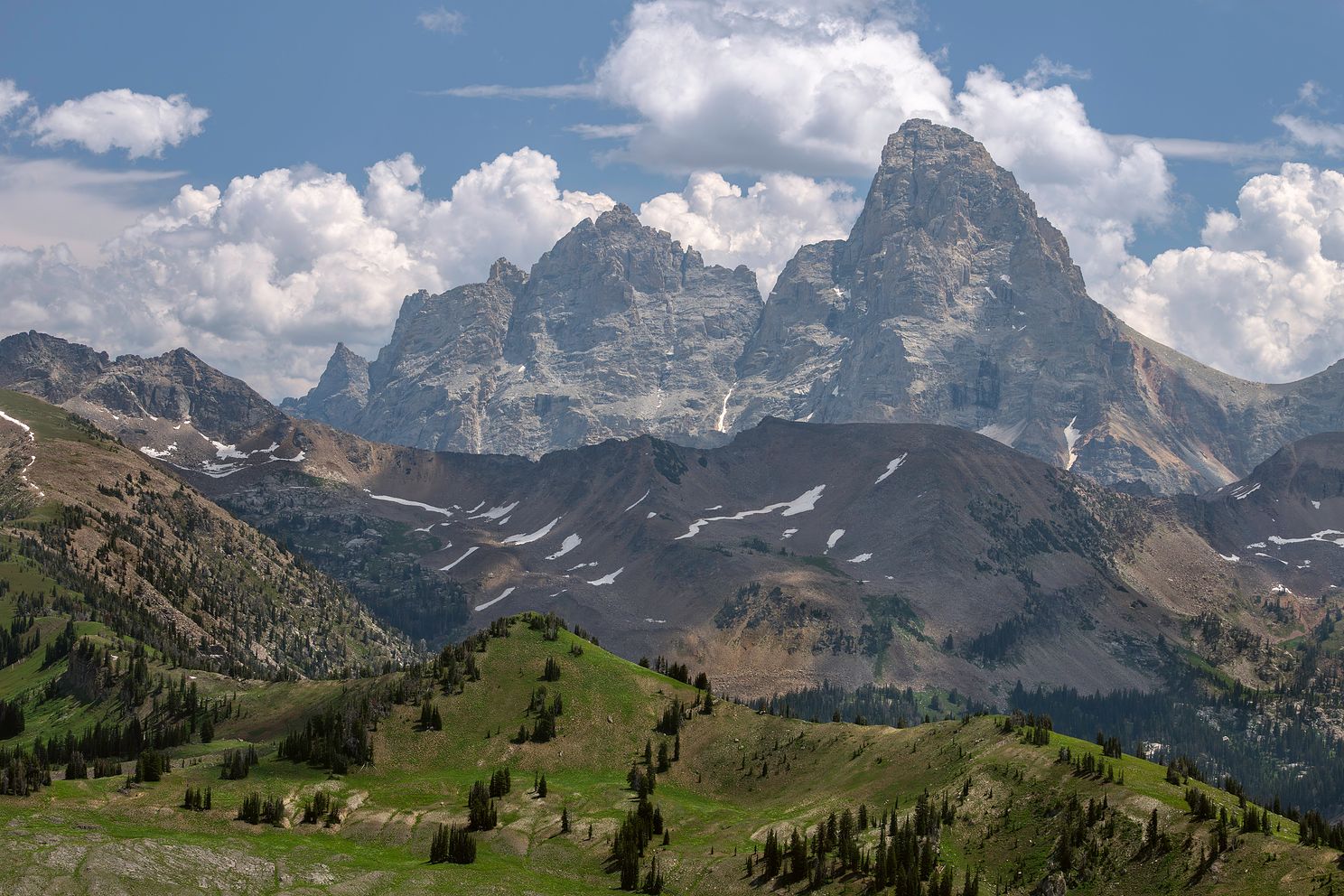
WESTERN FACES
While Mount Owen is the second-tallest peak in the Teton Range at 12,928 feet, it is visually diminished by the massive lateral bulk of the Grand when viewed from the east. It can easily be mistaken as a mere shoulder of its famous neighbor. But viewed from this high-altitude western vantage point, that illusion is shattered.
Owen's jagged, cathedral-like spires look quite dramatic when juxtaposed against the north face of Grand Teton. Between the two peaks sits a distinct, deep V-shaped notch known to climbers as the Gunsight Col: a prominent feature when viewed from the west, it creates an interesting geometric line in the frame.
From the Grand Targhee ridgeline, Mount Owen stands unmasked as a proud, independent fortress. It isn't hidden in the shadows; here, it stands shoulder-to-shoulder with the Grand.
We’ve been conditioned to think of the eastern flats of Jackson Hole as the "front" of the mountains, and the western side as the "backdoor." But history tells a different story.
When the first lenses were focused on these peaks and the first brushes touched canvas to prove to the world that these wilderness wonders existed, it happened from here.
The postcard views may belong to the east, but the true identity of the range was born in the west. This isn't the back side of the Tetons at all.
Historically, visually, and certainly from Thomas Moran’s point of view, you are looking at the front face.
The Three Tetons, oil on canvas, 20.6 inches x 30.5 inches
Part of the White House Collection, it is displayed frequently in the Oval Office.
William Henry Jackson's photographs of the Teton Range can be viewed at the Denver Public Library, Brigham Young University, and the J. Paul Getty Museum.